


Collections 2: The Persuasion of Motivation and Inspiration
August 2024 | Animals, Art and Design, Fashion, Food, Medical, Music, Political and Propaganda, Sports, Transportation
There's no getting around it, the ultimate decision to get up and show up day after day is yours alone. Find your purpose; find value in what you do; soak in your motivation and go. We sometimes need a little help though. Be it a kind word from a friend, family member, or stranger; a catchy slogan that resonates with your vibe; or the universe's subtle signs cast like a wide net waiting for you to step in for guidance or maybe a little reassurance. Whatever it takes, motivation is key to igniting the internal drive. In business, the motivation of a company's employees is a vital component of its overall success.

By far, one of the most recognized campaigns is for a poster titled “We Can Do It!” that was created in 1942 by artist J. Howard Miller from Pittsburgh. The image and rallying affirmation were designed specifically for Westinghouse Electric Corporation; to be displayed in their factories where women were encouraged and even celebrated for their patriotism for taking wartime jobs in the defense industries during WWll. The poster wasn't meant to be seen by the public though, let alone evolving from its original purpose to become a symbol that would inspire a whole new generation decades later.
The image became the face of feminism in the 1980s after being rediscovered. It was reproduced in numerous formats across the country and applied to all sorts of marketing strategies far removed from factories and wartime efforts.
Without any connection to the name however, the woman flexing her bicep of "We Can Do It" became synonymous with "Rosie the Riveter", "an allegorical cultural icon in the United States who represents the women who worked in factories and shipyards during World War II, many of whom produced munitions and war supplies. These women sometimes took entirely new jobs replacing the male workers who joined the military." Rosie the Riveter "was the star of a campaign aimed at recruiting female workers for defense industries during World War II." This symbol transcended its intended motive; it is one of a strong woman, independent, and full of promise and vitality -- this was the new image of a woman, both, in the workforce and beyond.
It was during the 1920s, however, that the birth of work incentive posters came about with the intention of energizing the workplace, command a good work ethic, and establish firm expectations of character when getting a job done. From 1923 to 1929, Mather & Company was at the forefront of this culture. Based out of Chicago, Illinois, it produced approximately 350 lithographic posters that were distributed across the United States.
Another example of Work Incentive posters came from Sheldon-Claire Co; these posters were produced in the late 1940s known as the Produce Better- Live Better series. Though Sheldon-Claire Co. distributed lithographic posters that rivaled Mather & Company's posters in 1935, the Produce Better- Live Better series really set them apart. Same premise as the other groups but these posters follow a formula: a clear, photo-offset graphic with highly saturated tones; an often lengthy caption; finished off with a prominent PRODUCE BETTER . LIVE BETTER tag in alternating black and red lettering against a yellow or white background, but mostly against the yellow background. It was a way of driving home the notion that better production equated to a better life.
As a part of Happiest Kid Find's growing inventory of posters, there are two specific collections that fit into the history of this genre that I wanted to bring into the spotlight: Clement Communications Masterpiece Program and ARGUS® .
Fast forward to the 1990s, and behold The Masterpiece Program by Clement Communications, located in Concordville, Pennsylvania, The company was originally founded in 1919. Theor mission was, and still is, to help "employers motivate employees and change behavior to create a safer workplace." They currently develop and issue "programs and materials for business, educational institutions and government, including software, newsletters and posters to help organizations communicate with employees and customers."
One of twenty-five unique poster programs that Clement Communications created to gain a broader appeal, the clever utilization of Norman Rockwell's quintessential images, not only solidified the importance of his work but helped to enhance the objective of the messages.
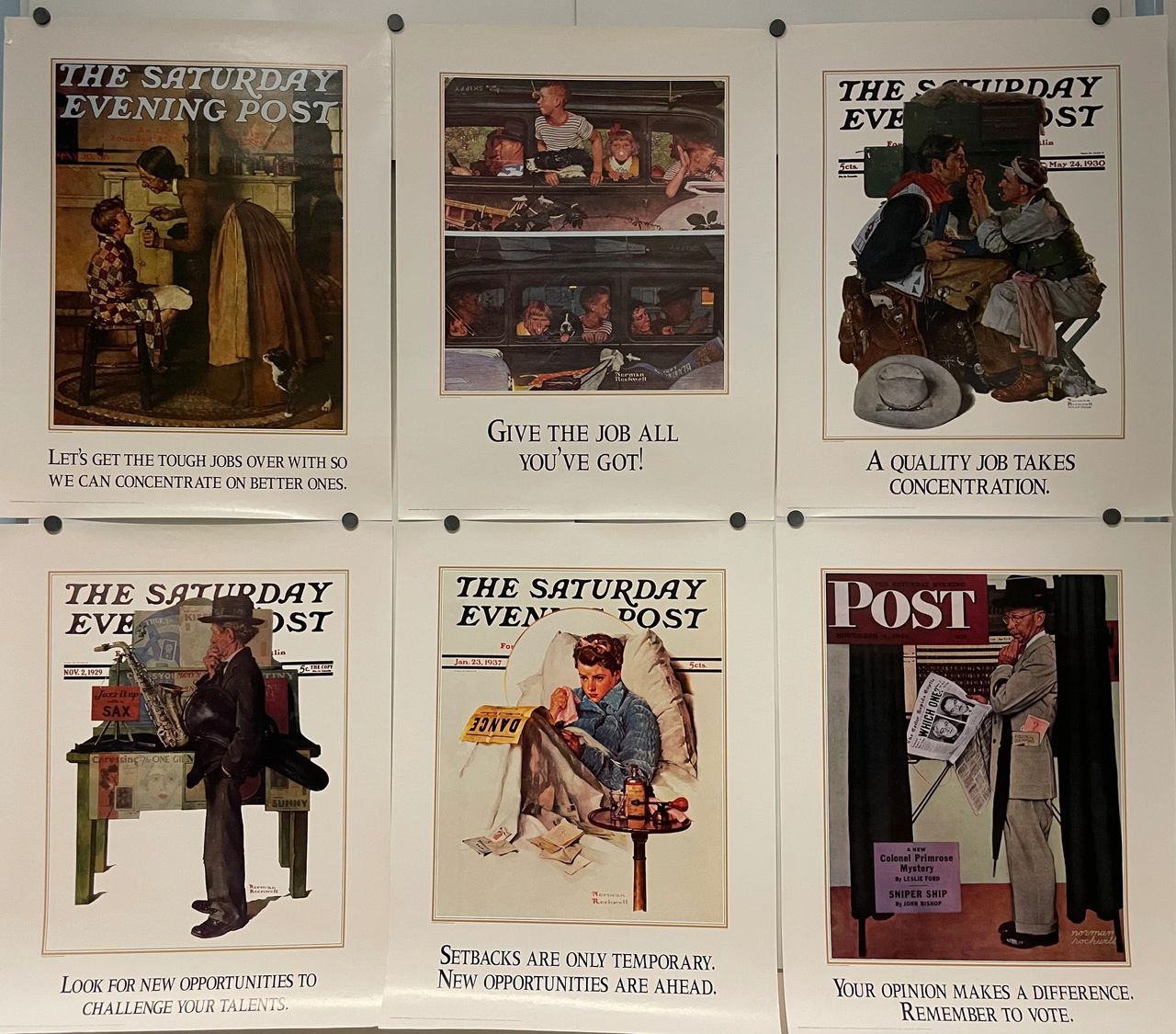
Selection of Norman Rockwell images licensed for The Masterpiece Program by Clement Communications, 1990s
About two years ago, an opportunity to acquire a small group of ARGUS® motivational and inspirational posters from the 1970s presented itself Although I haven't been able to find specific information about the company from this period, I was informed that TREND enterprises, Inc. acquired the intellectual property from ARGUS® in the early 2000s and continued to generate and sell the posters since that time. To this day, Trend Enterprises creates "educational classroom supplies for teachers, parents, and students."
